
Diving into Change Fatigue the half full, llc, way
Author: William Patenaude

“The secret of change is to focus all of your energy, not on fighting the old, but on building the new.” — Dan Millman, Way of the Peaceful Warrior
During my three decades working in state government — particularly in environmental regulation — change arrived in relentless waves. New administrations reset priorities.
Federal requirements and funding formulas shifted. We implemented new data systems, absorbed fresh compliance mandates and new realities like climate change, and restructured teams amid budget cycles and public scrutiny.
Many initiatives carried real promise. More than a few did not. In those cases, after the second or third overlapping effort to reform the same program, process, or work product, I watched capable, dedicated colleagues grow quiet. Not resistant in the classic sense. Just weary and sometimes suspicious of the why behind proposals for change.
“Here we go again” and “we’ve tried this before” often went from a whisper to an anthem. Deadlines slipped, creativity dulled, and the very people we needed most to champion the work had less left to give.
It wasn’t a failure of will; it was a growing fatigue towards change.
You’ve probably experienced this. At all levels across the professional spectrum, AI tools are landing fast, policies and priorities change overnight, and restructurings are demanded for “agility.” Not surprisingly, the research confirms what many leaders sense: the warp speed of change calls for a style of leadership that prioritizes the needs of people.
Recent Gartner research confirms what many leaders sense: change fatigue isn’t individual weakness. It’s becoming a global reality. In a July 2024 survey of HR leaders, 73% reported their employees are fatigued from change, and 74% said their managers are not equipped to lead change.
The Center for Creative Leadership (CCL) puts it plainly in its July 2025 article on leading through continual evolution: change fatigue is “a state of exhaustion that occurs when individuals or organizations experience continuous, rapid, or overwhelming changes.” CCL likens a team’s capacity to a bank account filled with energy, attention, and interest. Every change — big or small, even the positive ones — requires a withdrawal. When people never get the chance to rebuild their reserves with time, tools, and support, even modest new demands can feel overwhelming.
This is more than an engagement dip. It’s a strategic risk to productivity, innovation, retention, culture, and the well-being of human beings.
So why does change fatigue take hold, and how do we lead through it? Let’s dive in…
Unpacking Change Fatigue
Too often we may find ourselves managing the mechanics of change while under-investing in how it lands on people. We may assume that everyone values or responds to changes — big or small — the same way.
But change fatigue carries a deeply personal texture. Depending on our individual strengths, lived experiences, and beliefs and values, we each experience change differently. Some of us jump-in headfirst, with excitement and a “I can’t wait to see where this goes” mentality. Others may look to the past, not to preserve it at all costs (although, that may be our first response), but for guidance—for proven standards and structures that might have something to offer the shifting realities of the current moment. But no matter how each of us experiences change, it requires us as leaders to pause and really consider how shifts affect each of us and our teams differently.
Related Reading: Catalyzing Transformation Through Forwards®
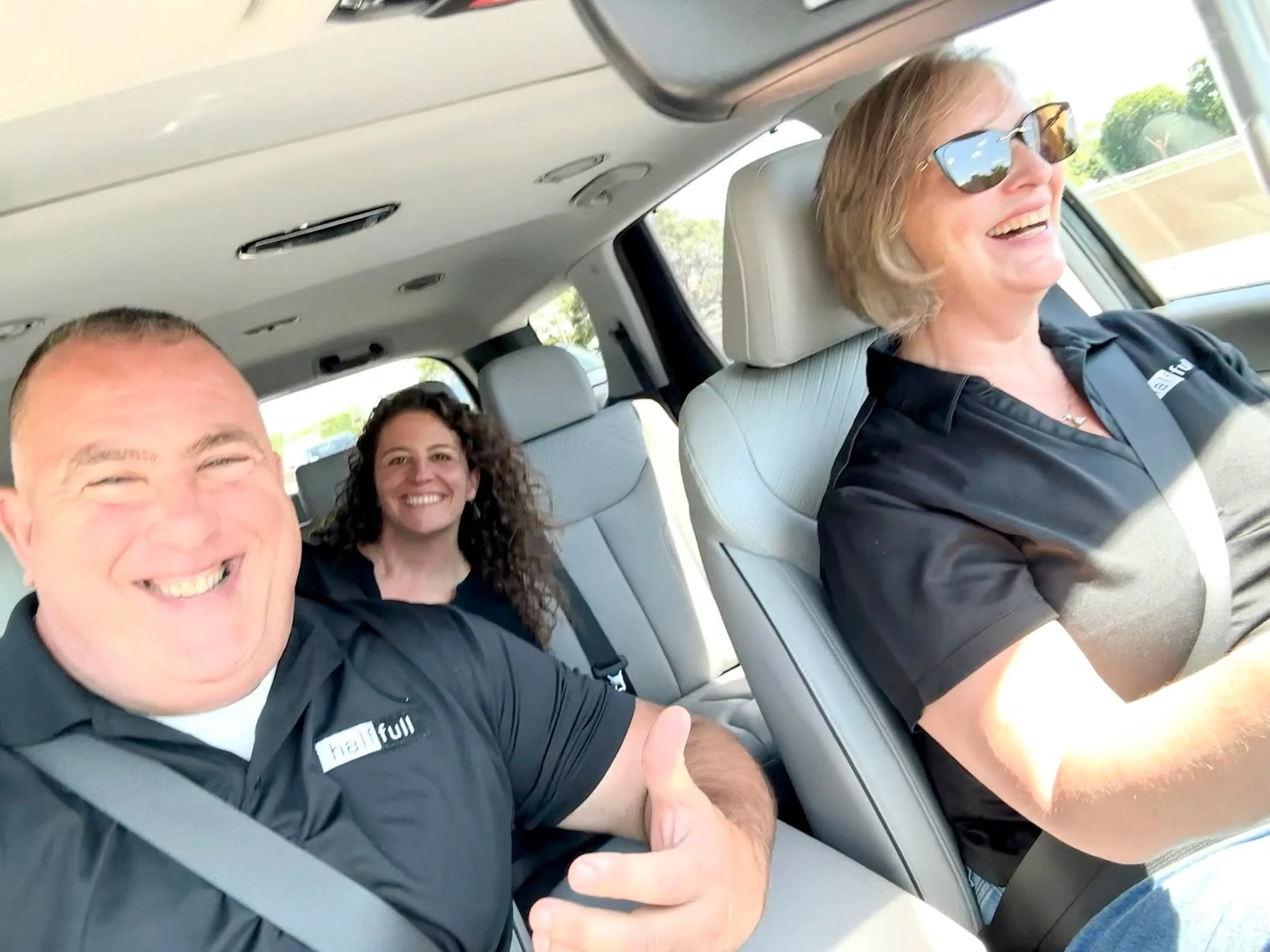
Members of the half full, llc team on a road trip to help a team move forward!
In workplaces where initiatives arrive in rapid, overlapping waves, there is rarely time to pause and reconnect with what has worked before. The result is not resistance for its own sake — it is genuine disorientation and quiet exhaustion.
At half full, llc, our mission is to help teams and individuals overcome obstacles that we find in the way of moving forward. Our approach is guided by our five core values that speak directly to the human experience of change fatigue. These values shape how we facilitate the “how” of a team’s next steps — with simple, effective, and optimistic methods that build positive workplace cultures.
Value: It’s about we.
Change fatigue often deepens when people feel change is happening to them rather than with them. When leaders foster genuine collaboration — inviting input on pacing, sequencing, and the support people actually need — teams regain a sense of agency and shared purpose. The load feels lighter when it is carried together.
Value: We do not judge or assume.
We believe everyone is unique, and we respect that everyone has their own opinion, way of doing things and way of being. What may look like quiet withdrawal or skepticism may actually be a strength — a call to hit pause and evaluate the good that may be unintentionally erased by a proposed change, or a risk as yet unseen. By suspending judgment and assumptions, leaders create the psychological safety for people to name what is depleting or worrying them — opening the door to real, targeted improvements instead of one-size-fits-all mandates.
Value: We listen to understand.
We believe active listening is a vital key to successful relationships. We listen with intent. We ask questions. We allow what we hear to challenge us. In the noise of constant change, people need to be heard before they are asked to adapt again and again. True listening reveals trust and practical solutions — whether that means reconnecting new initiatives to proven past successes, adjusting timelines, or building in recovery time. This is not just empathy — it is the deeper intelligence leaders need to guide teams through change without depleting them.
Value: We are grateful.
We are grateful for each new day, the people we meet in our work, and the opportunities we are given. In a world of perpetual motion, people need to know that their adaptability and effort are seen. Authentic, fact-based gratitude replenishes that “bank account” of emotional reserves. It reinforces that we are navigating this together. And it builds the goodwill required for the next wave of adaptation.
Value: We give back.
We are committed to corporate social responsibility, and our “do well, do good” business model drives our motivation for helping others in the community. Sustainable change requires deliberate “deposits” back into people’s capacity — time for reflection, opportunities for skill-building, space for celebration, or simply the gift of a paused rollout when the account is overdrawn. After all, giving back can prevent the depletion of change capacity from becoming the norm.
These values are not abstract ideals. They are practical tools for leaders who want change efforts to succeed without breaking the very people meant to carry them. When organizations lead by treating team members as partners — listening deeply, suspending judgment, and giving back to their energy and spirit — change fatigue shifts from an invisible drain into an addressable obstacle — one we can move past and even grow from together.
William L. Patenaude is a Flex Facilitator with half full, llc and brings decades of experience from state government service into leadership development, teambuilding, and culture work across sectors.